In the rarefied world of high-end architecture and interior design, your work is your résumé — but in the digital age, the way you present that work has become more decisive than the work itself.
A paradox has emerged in luxury design: it is not just the physical structures you have built that define your success, but the digital vessels that carry their stories. This is the millisecond decision — the 0.05-second window during which a potential client decides whether your brand is capable of handling their multi-million-dollar vision. If your digital presentation doesn't match the level of your physical work, you have already lost the opportunity before a single word has been exchanged.
For the modern architect or interior designer, the website is the new "first meeting." It is the digital equivalent of a private gallery show — a curated experience that must communicate your aesthetic sensibility, your technical precision, and your commitment to luxury. This guide explores the deep-seated psychology of portfolio presentation and explains why how you show your work is just as important as the work itself. For a structural companion read, see our ultimate guide to interior designer websites.
01The Psychology of Perception: How Presentation Builds Trust
Trust in the luxury sector is a fragile commodity. When a client is looking to commission a designer for a legacy project — a primary residence, a hospitality brand, a private gallery — they are searching for a partner who understands the nuances of space, rhythm, and material. A cluttered, dated, or poorly performing portfolio communicates a fundamental lack of attention to detail, which is precisely the trait the client is paying a premium for.
Cognitive load plays a substantial role here. In high-end design, we strive for fluency — the ease with which information is processed. A well-presented portfolio reduces cognitive load, allowing the visitor to focus entirely on the emotional impact of your work. When a website feels "easy" and "expensive," that feeling is subconsciously transferred to the perceived quality of your architectural service. Research from the Nielsen Norman Group on the aesthetic–usability effect confirms that users perceive beautiful designs as more usable, regardless of actual functionality.
- The Halo Effect: a high-quality website leads users to assume high-quality architectural work.
- Cognitive Fluency: simple, elegant layouts are processed faster and associated with intelligence and trust.
- Validation: premium presentation justifies your price point and filters out low-value leads.
- Anchoring: the first visual impression sets the ceiling for perceived studio quality across the entire session.
02Storytelling vs. Listing: Why Case Studies Beat Grids
The "infinite grid" of small thumbnails is a relic of early web design. While efficient for stock-photo libraries or fast-fashion retailers, it is disastrous for conveying the depth and soul of an architectural project. Luxury projects deserve to be told as cinematic narratives, not listed as inventory. A grid suggests you are a commodity; a case study proves you are a consultant.
A narrative-driven case study allows you to walk the client through the spatial logic of a project. It begins with the challenge — the site's constraints, the client's aspirations — and follows the journey through sketches and renders to the final, breathtaking reality. This approach engages the client emotionally, positioning your work not as a set of drawings but as a solved puzzle of human experience. Award benchmarks on Awwwards show that the highest-scoring design studio sites consistently abandon grids in favour of long-form, scroll-driven narratives.
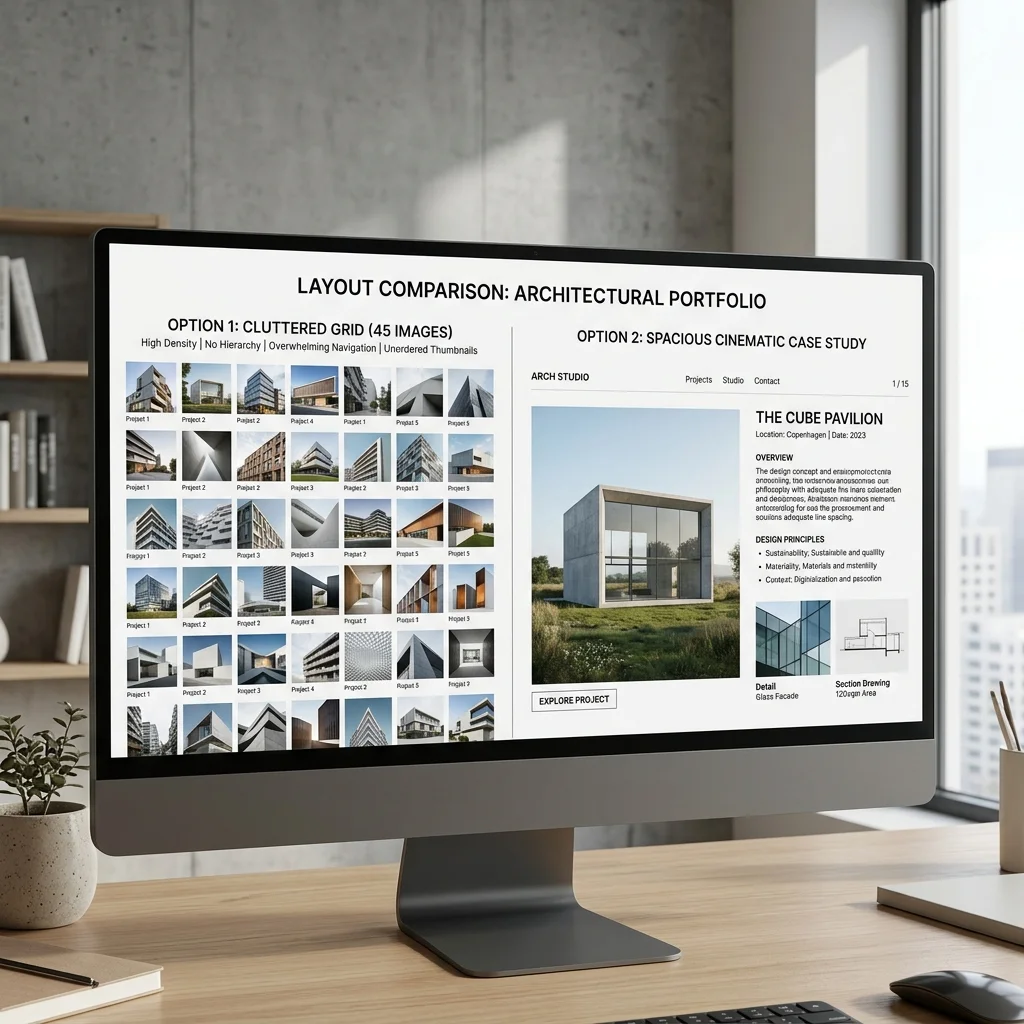
Structuring the Narrative Arc
Every project page should follow a deliberate sequence: an opening hero that establishes mood, a brief that frames the constraint, a process section that demonstrates thinking, and a finished sequence that delivers payoff. This pacing mirrors the experience of walking through a well-designed space — there is intention behind every transition. Curate ruthlessly: four to six fully developed case studies will outperform twenty thinly documented ones every time.
Pacing and Visual Rhythm
Alternate between full-bleed wide shots and tighter material details. The visual rhythm of a project page should echo the spatial rhythm of the project itself — moments of expansion followed by moments of intimacy. Long, uniform image grids flatten this rhythm and signal that you have not curated.
- Structure every project with a clear beginning (the brief), middle (the process), and end (the outcome).
- Use cinematic pacing — large-scale photography for awe, detail shots for precision.
- Explain the "why" behind key design decisions to demonstrate authority.
- Treat each project page as a self-contained landing experience, not a gallery thumbnail.
03The "Luxury" of White Space: Why Less Is More
In physical architecture, space is the ultimate luxury. High ceilings, wide corridors, and uncluttered rooms are hallmarks of premium design. The same principle applies to your digital portfolio. White space — or negative space — is not "empty" space; it is a powerful design tool that directs focus, creates calm, and establishes premium rhythm.
A website packed with too many images, buttons, and text blocks feels anxious. It suggests a lack of confidence. By embracing generous margins and padding, you allow your work to take centre stage — communicating that your work is important enough to deserve its own room. In the digital realm, white space is the silence that allows the music of your design to be heard. Smashing Magazine has documented how higher whitespace ratios correlate with perceived sophistication across luxury verticals.
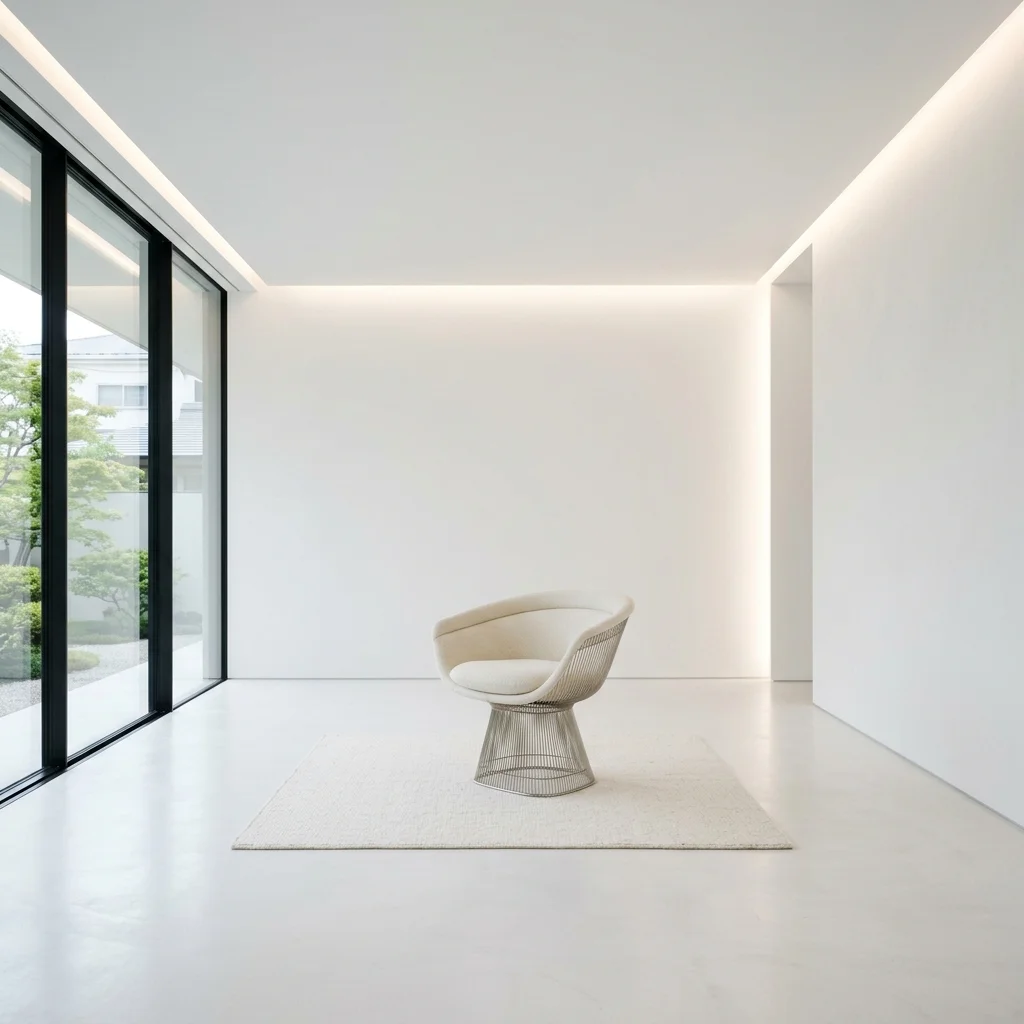
Editorial Margins
Treat your page like a luxury magazine spread. Margins of at least 8–10rem of vertical breathing room between content sections on desktop, combined with strict adherence to a single content column for reading text, separate the editorial from the corporate. Resist the urge to fill every column inch.
Focus Management
Use white space to lead the eye toward CTAs and key project details. A single call-to-action floating in deliberate space converts far better than five competing CTAs scattered across a busy hero — because it is the only thing competing for the visitor's attention.
- Give images visual breathing room so they can be appreciated individually.
- Use consistent, generous margins to create order and high-end brand feel.
- Direct attention with white space, not with weight — fewer, larger elements over many small ones.
04Technical Fidelity: Performance and Resolution
In high-end design, "close enough" is never good enough. The same applies to the technical performance of your website. A portfolio that takes more than three seconds to load or shows pixelated images on a 5K display is a brand liability. Technical fidelity is the digital version of structural integrity; if the foundation is shaky, the entire project is questioned.
Implementing modern image formats like WebP or AVIF, leveraging high-performance CDNs, and ensuring smooth, stutter-free animations are non-negotiable requirements for a premium site. Your website must feel as solid and considered as the marble in your projects. Google's Core Web Vitals — Largest Contentful Paint (LCP), Cumulative Layout Shift (CLS), and Interaction to Next Paint (INP) — directly influence both rankings and first impressions.
Image Delivery That Doesn't Compromise
Use srcset and sizes to serve appropriately sized images per viewport. Pair this with a CDN-backed object store such as Cloudflare R2 or AWS CloudFront so international clients see the same speed as local ones. Lazy load anything below the fold, but never lazy load your hero image — that destroys LCP.
Animation as Polish, Not Decoration
Use scroll-driven libraries like GSAP for cinematic transitions, but constrain motion to subtle reveals and parallax. Heavy animation libraries can torch your INP score. Test continuously on mid-tier mobile hardware — that is where your performance budget actually lives.
- Retina optimisation: always serve high-DPI assets for modern displays.
- LCP under 2.5s on every project page — no exceptions.
- WebP/AVIF with responsive
srcsetas the default for portfolio imagery. - Smooth, intentional motion — never gratuitous parallax or layout shifts.
05Presentation Formats: Which Earns the Brief?
Not all portfolio formats convert equally. The format you choose telegraphs the type of studio you are — boutique, productised, or commodity. The table below compares the three dominant portfolio formats in 2026 against the criteria that matter for high-value commissions: depth of storytelling, perceived prestige, SEO leverage, and production cost.
| Criterion | Grid Gallery | Hybrid (Grid + Case Studies) | Full Narrative Case Study |
|---|---|---|---|
| Storytelling Depth | Low | Medium | High — full project narrative |
| Perceived Prestige | Low — commodity feel | Medium | High — editorial / gallery feel |
| SEO Leverage | Low — one page for all work | Medium | High — one indexed page per project |
| Production Cost | Low | Medium | High — requires copy + curation |
| Best For | Volume studios | Growing studios | Luxury / boutique studios |
| Avg. Time on Page | 45–90s | 1:30–3:00 | 3:00–6:30 |
The pattern is unambiguous: if your business model depends on winning high-ticket commissions rather than maximising lead volume, the full narrative case study is the only credible format. Hybrid setups can work for studios in transition, but a pure grid signals "commodity" the moment a sophisticated buyer arrives.
- Pure grids suit volume — not luxury — work.
- Full narrative case studies are the only format that earns prestige perception.
- Hybrids are an acceptable transitional state, not a destination.
- Each case study should live at its own SEO-indexable URL.
06Your Portfolio as a Silent Salesman
Your website works for you 24/7. When presented correctly, it acts as a silent salesman — pre-qualifying leads, building trust, and establishing your authority before you've even spoken to a potential client. Investing in high-fidelity portfolio presentation is not merely an aesthetic choice; it is a strategic business move that directly impacts your ability to secure high-value commissions.
The studios that win the best briefs in 2026 are not necessarily those with the most projects — they are those whose digital presentation matches the calibre of their physical work. The bar for digital excellence has never been higher. Don't let a mediocre presentation hold back world-class work.
The Compounding Effect of Polish
Small upgrades — better typography, tighter copy, sharper imagery — compound over time. Each visitor who leaves with a slightly stronger impression is one more person who repeats your studio name in a conversation that you will never witness. Presentation polish is the most leveraged form of word-of-mouth investment available to a designer.
What "Done" Actually Looks Like
A finished portfolio is one where every element earns its place. There is no orphan page, no placeholder copy, no stretched photography, no broken alignment. The site reads as a single, intentional artefact — the same way a finished room does. That coherence is what the high-end client is buying.
- Pre-qualifies leads and filters mismatched prospects automatically.
- Establishes authority before the first conversation.
- Compounds word-of-mouth — every visitor is a potential referrer.
- Earns the right to higher fees by signalling craft at every touchpoint.
07Frequently Asked Questions
The questions we hear most often from architects and interior designers refining their portfolio presentation. Each answer is grounded in conversion data, UX research, and the realities of the luxury design market.
srcset). This ensures the browser only downloads the exact size needed for the visitor's screen, maintaining speed without sacrificing quality. Pair this with WebP or AVIF for further savings.Ready to Elevate Your Portfolio?
At AtelierEvo, we build premium, performance-optimised websites for architects and designers who refuse to compromise on either aesthetics or technical excellence.
If your physical work deserves better digital presentation, let's talk about what a high-fidelity portfolio looks like for your studio.
Start Your Project →