In the high-stakes world of high-end architecture, your website is your most important employee. It works 24/7, making a decisive argument for your credibility before you ever pick up the phone.
For the modern architect, the homepage is no longer a digital business card — it is a complex psychological validator. It is the millisecond decision: the 0.05-second window in which a potential client commissioning a multi-million dollar project forms an indelible impression of your firm's capability. Research from the Nielsen Norman Group confirms that aesthetic judgements are automatic and nearly instantaneous — and that they persist throughout the entire session, colouring every subsequent interaction with your brand.
If your digital presentation lacks the precision of your physical structures, the trust gap is insurmountable. In this guide, we explore the structural psychology of architect homepages. We move beyond generic "templates" to examine three distinct layout philosophies proven to convert high-net-worth leads in 2026, compare them in a structured framework, and identify the core elements that no architecture homepage can afford to omit. For a deeper look at the portfolio pages that follow, see our companion guide on why portfolio presentation matters for high-end designers.
01The Cinematic Narrative: For Award-Winning Studios
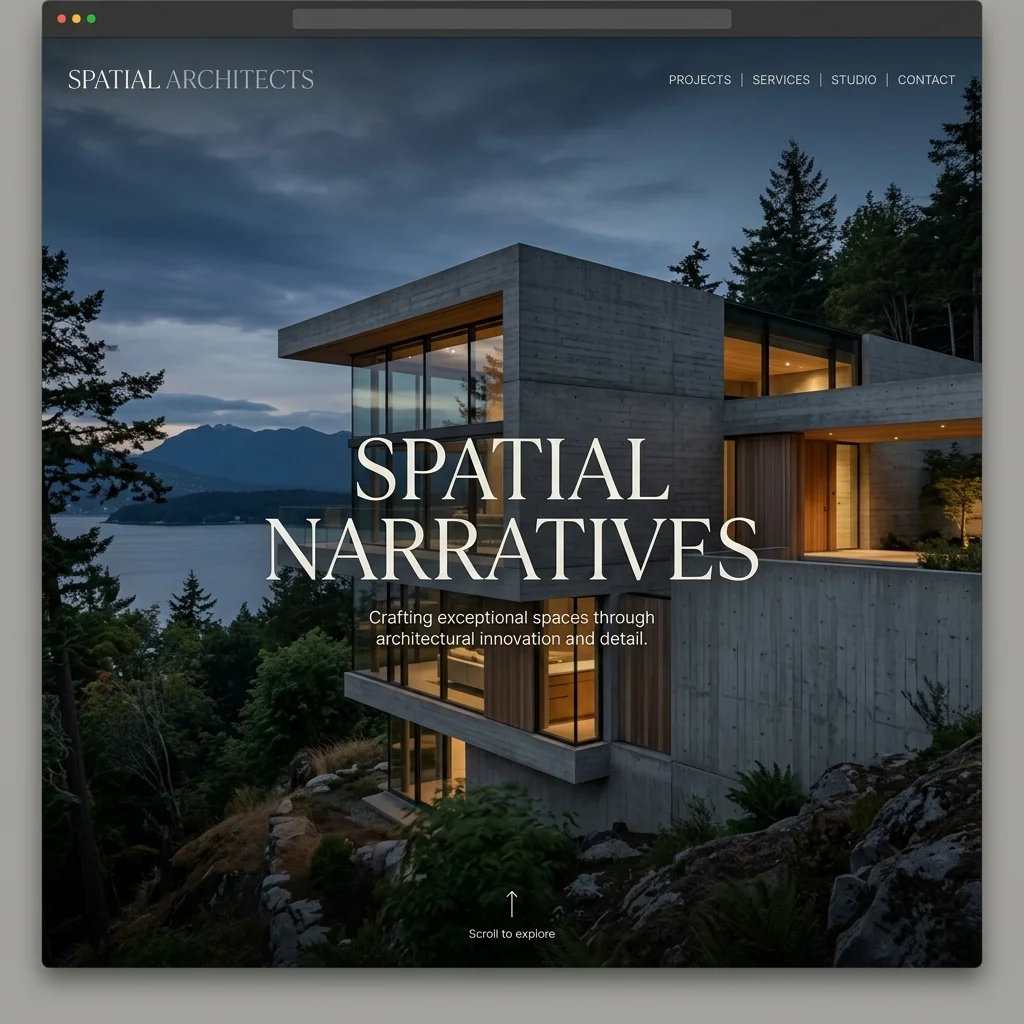
The Cinematic Narrative layout is designed for firms that specialise in legacy projects where emotional impact is as vital as structural integrity. This layout typically features a full-screen video hero or a series of immersive, high-resolution project captures that slowly dissolve into one another. It prioritises mood over immediate technical detail, drawing the visitor into the studio's unique philosophy before a word of copy is read.
This layout functions like a private gallery show. By using large-scale, high-fidelity visuals, you force the user to slow down. In a digital world of fast scrolling, deliberate slowness is a signal of luxury. The goal is not to show everything you have ever built — it is to present a singular, breathtaking vision that captures the essence of your practice. Studios that have won awards on Awwwards overwhelmingly favour this approach for good reason.
Why It Works for High-End Leads
High-ticket clients are not just buying a building — they are buying a viewpoint. A cinematic homepage proves that you understand atmosphere, rhythm, and light: the intangibles of great architecture. It pre-filters leads by setting a high bar for aesthetic appreciation, so when a client finally reaches out, they are already aligned with your philosophy.
Implementation Essentials
Compress video to H.265 or WebM and keep the file under 5MB. Always provide a high-quality still poster image that renders immediately while the video buffers — this is the element that determines your LCP score. A "ghost" header that only appears on scroll keeps the initial frame uncluttered and cinematic.
- Use 4K-optimised video (H.265 or WebM) for atmospheric mood without lag.
- Minimise UI overlays — use a ghost header that only appears on scroll.
- Build a 20–30s sizzle reel of your 3 best projects rather than looping one static scene.
- Ensure hero typography is subtle but impeccably kerned — it competes with the visual.
- Always include a muted autoplay, never sound-on — sound destroys the luxury feel.
02The Grid of Authority: For Proven Track Records
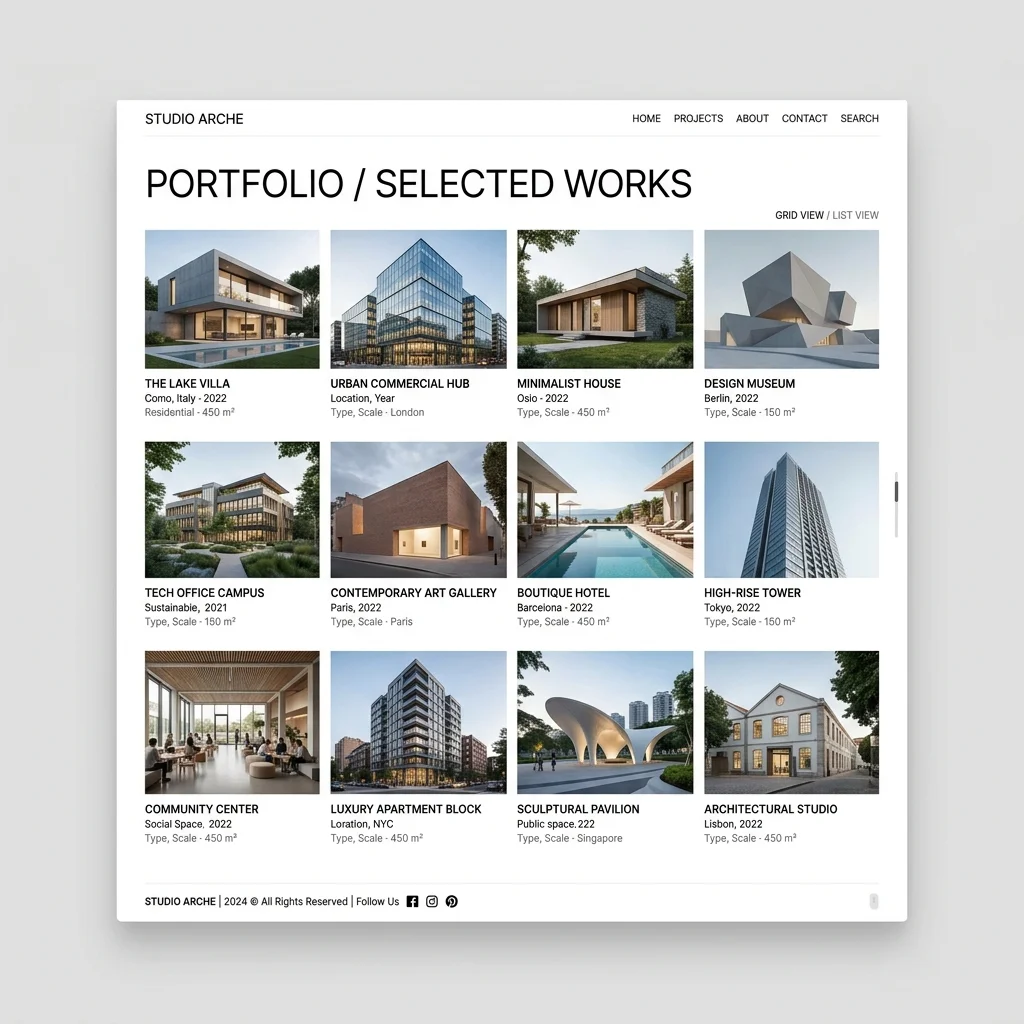
For practices that pride themselves on consistent, high-quality output across a diverse range of project types, the Grid of Authority is the gold standard. This is not a chaotic Pinterest grid — it is a disciplined, editorial-style modular system that echoes the precision of a plan drawing. It communicates efficiency, experience, and a deep understanding of varied spatial challenges.
The strength of this layout lies in its rhythm. A repeating grid creates a sense of order and reliability, allowing potential clients to browse at their own pace and find projects that specifically match their needs. It is particularly effective for studios working across multiple sectors — residential, commercial, hospitality — because the grid treats each project as an equal, indexed asset rather than a featured hero.
The Psychology of the Grid
A well-organised grid signals technical mastery. In architectural terms, the grid represents the underlying logic of a plan. When a client sees a perfectly balanced grid on your homepage, they subconsciously associate that balance with your ability to manage a complex, multi-stakeholder construction project. The critical variable is whitespace — each project card requires enough breathing room to be appreciated individually. A tightly packed grid reads as anxiety; a generous grid reads as confidence.
- Maintain consistent aspect ratios (4:3 or 16:9) to signal mathematical precision.
- Use generous gutters (24–48px on desktop) for an editorial, high-end feel.
- Incorporate metadata (city, typology, award) visible on hover to add depth without clutter.
- Never show more than 12 projects on initial load — progressive disclosure maintains intrigue.
03The Minimalist Monolith: For Ultra-Boutique Firms
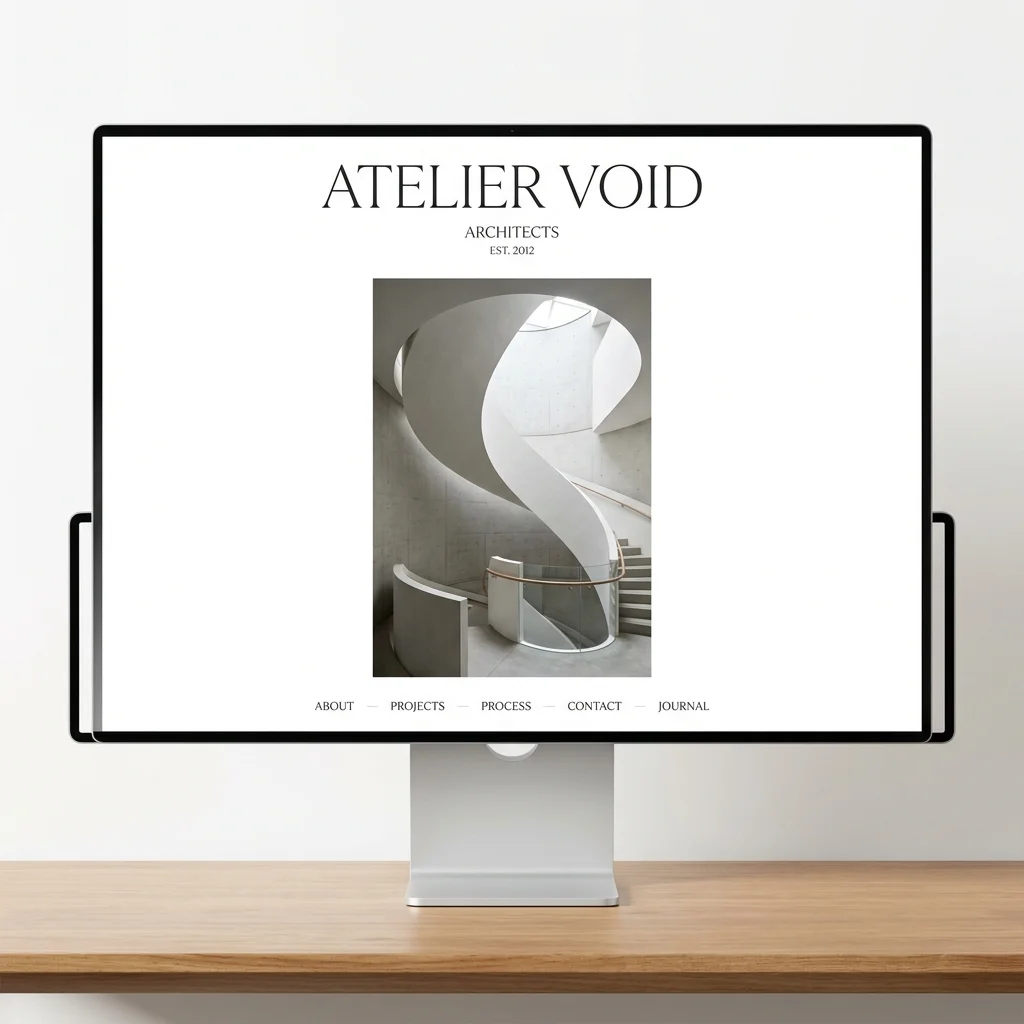
The Minimalist Monolith is an exercise in extreme confidence. By showing a single striking visual and surrounding it with vast amounts of white space, you signal that your firm is selective, prestigious, and highly sought-after. This layout makes a bold statement: "We don't need to show everything; our reputation and our singular vision speak for themselves."
This layout is most effective for boutique practices specialising in ultra-high-end, experimental, or sculptural architecture. It focuses the visitor's attention entirely on a single focal point, creating a monolithic impression that is difficult to forget. In UX terms, this is sometimes called "Restorative Design" — it provides calm and clarity that contrasts sharply with the noise of the modern web, and that contrast itself is a luxury signal.
Designing for the 1%
For the ultra-wealthy client, time is the most valuable commodity. The Minimalist Monolith respects that time by removing all decisions. It doesn't ask the user to hunt for information — it presents a singular, high-value visual that defines the studio's entire aesthetic. This layout is high-risk, high-reward: the image you choose must be your absolute masterpiece, the typography must be flawless, and the loading performance must be impeccable. A Minimalist Monolith that loads slowly is an immediate contradiction.
- Treat white space as an active architectural element, not empty area to fill.
- Use oversized, thin-weight serif or sans-serif typography for an "old money" authority feel.
- Select your single best image — there is no room for a secondary visual in this layout.
- Subtle parallax on the hero image adds depth without breaking the calm.
- Keep the navigation invisible until needed — a floating hamburger or scroll-reveal header.
04Layout Comparison: Choosing the Right Framework
The right layout is not an aesthetic preference — it is a strategic decision based on your studio's business model, portfolio depth, and target client profile. The table below compares the three frameworks across the dimensions that drive conversion for high-value architecture commissions. Use it to identify your starting point, then adapt from there.
| Criterion | Cinematic Narrative | Grid of Authority | Minimalist Monolith |
|---|---|---|---|
| Best For | Award-winning, legacy studios | Multi-sector established practices | Ultra-boutique, experimental firms |
| Portfolio Depth Required | 3–5 exceptional projects | 10+ varied projects | 1 masterpiece |
| Avg. Session Duration | High (+44% vs baseline) | Medium | High (if the image lands) |
| Lead Pre-Qualification | Very high — filters by taste | Medium | Very high — filters by budget |
| Performance Risk | High (video LCP) | Medium (grid images) | Low (single image) |
| SEO Surface Area | Low — one hero narrative | High — multiple indexed entries | Very low |
05Core Strategy: Elements Every Homepage Needs
Regardless of layout philosophy, high-conversion architecture homepages share a set of non-negotiable structural elements. These are the functional anchors that turn a beautiful website into a lead-generating machine. Getting them right is less about design taste and more about understanding the psychological journey of a high-value prospect.
First: a clear, specific value proposition visible without scrolling. Not "We are an architecture firm" — but "We design light-filled homes for modern families in London" or "Civic architecture for the next generation of urban environments." This answers the visitor's subconscious question within three seconds: Are these people the right fit for my vision?
Social Proof Done Right
High-end clients are risk-averse. They need to know that peers, press, and the industry at large validate your work before they commit. The most effective social proof for architecture studios is not a testimonials carousel — it is a subtle row of editorial logos (Dezeen, ArchDaily, Wallpaper*) or a small "Award Winner" seal from RIBA, AIA, or Pritzker. Position these immediately below the hero — never buried in a footer. Contextual proof, placed where the visitor is already engaged, converts significantly better than isolated accolades.
The Conversion Funnel Architecture
Every homepage section should nudge the visitor toward a single next step: a project case study or a consultation request. Design your homepage as a funnel — not a brochure — with each scroll depth increasing the visitor's trust and specificity. According to Smashing Magazine's conversion research, reducing the number of decisions required on a page consistently lifts completion rates. For architecture, the ideal homepage CTA is "View Projects" not "Contact" — let the case studies close the lead.
- Specific value proposition above the fold — who you build for, not just that you build.
- Editorial press logos or award marks immediately below the hero.
- One primary CTA (View Projects) — not three competing actions.
- A frictionless enquiry form: name, email, brief — nothing more.
- Performance as a non-negotiable: LCP under 2.5s on every device.
06Mobile-First Future: The 60% Opportunity
More than half of your potential clients will discover your studio on a mobile device — while commuting, between meetings, or during a casual browse. Refactoring a complex widescreen architectural layout for a 6-inch vertical screen is one of the most consequential challenges in modern studio web design, and it is almost universally underestimated.
A mobile-optimised homepage is not a smaller version of the desktop site. It is a re-engineered experience. A wide horizontal hero image on desktop should transition to a striking vertical detail shot on mobile — height, not width, conveys scale on a portrait screen. Horizontal scroll sections, common on architecture sites, must be replaced with vertical stacks that feel natural to the thumb. Navigation must be accessible within reach of a single hand, and the enquiry CTA must never require more than two taps.
Performance on Mobile Networks
Even with 5G rollout, real-world mobile connections are inconsistent. Use srcset and sizes attributes to serve appropriately sized images per viewport. A desktop hero served at 1400px to a mobile screen wastes bandwidth and destroys your LCP score. Pair this with WebP or AVIF compression — both formats deliver near-identical visual quality to JPEG at 25–35% smaller file sizes.
- Vertical crops for mobile hero sections — show height, not width.
- Thumb-friendly touch targets: minimum 44×44px for all interactive elements.
- WebP/AVIF with
srcsetfor fast loads on variable connections. - Sticky header or bottom bar with a persistent "Enquire" CTA.
- Replace horizontal scroll with vertical stacks on screens under 768px.
07Frequently Asked Questions
The questions we hear most often from architects evaluating or redesigning their homepage. Each answer is grounded in conversion data, UX research, and the realities of the luxury architecture market in 2026.
Elevate Your Digital Front Door
Your homepage is the digital validator of your physical work. At AtelierEvo, we build high-performance, high-aesthetic websites for architects who refuse to compromise on either.
If your studio's physical work deserves a homepage that matches it in precision and impact, let's build it together.
Start Your Project →